
A few words on confirm-shaming
Exposing one of the most shameful deceptive patterns in design


"No thanks, I like to make bad choices"
Sorry, what?
This screenshot shows one of many egregious examples of confirm-shaming I've seen online.
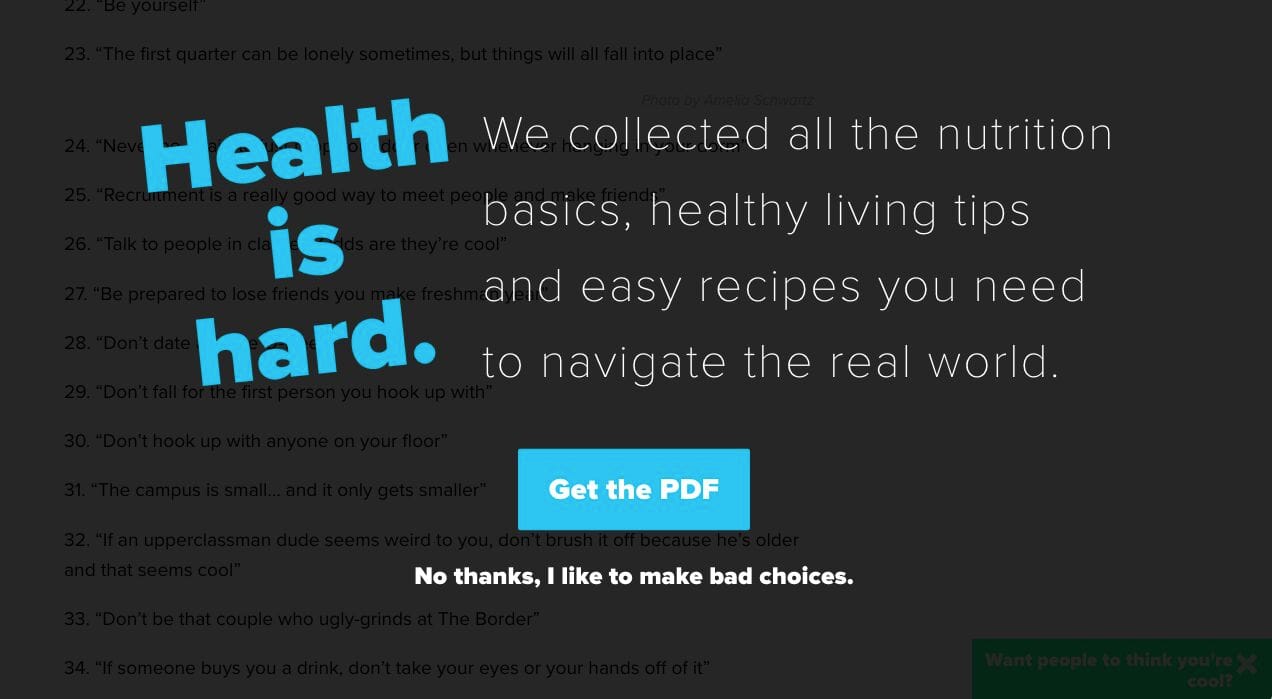

Don't want the PDF guide? The only way to decline is to declare you're a bad person.
Confirm-shaming uses words that make the user feel guilty for not taking the desired action.
- Don't want to enter your email for a coupon? "Nah, I'd rather pay full price"
- Not interested in that clothing subscription box? "No thanks, I don't want to look my best"
- Don't want food tips delivered to your inbox? "Nope, I don't eat healthy food"
Confirm-shaming is a deceptive pattern, or dark pattern, a term for questionable design practices that manipulate users into doing things they didn't intend to do.
There's an entire Tumblr site dedicated to confirm-shaming:


And experts like Harry Brignull have created websites to expose deceptive interfaces and educate the public:

Every time you…
- can't find the 'X' to close an obnoxious pop-up
- need to jump through hoops to unsubscribe from a service you no longer need
- spot a confusing double negative when choosing communication preferences on a social media app
- are prompted to add more items to your cart to get a discount at checkout
…chances are you're being deliberately misled.
Some patterns are easy to spot, while others are more subtle and potentially more dangerous.
So how can designers recognize and avoid them?
The European Data Protection Board has published guidelines on assessing deceptive social media interfaces that infringe GDPR requirements.


Even if you don't work in the EU, it's a great resource to learn about ethical design principles and the types of deceptive patterns that exist.

I'm Elisa, an Italian content designer and translator at heart who believes good design is service. This is where I document my life in UX and writing.
Let’s talk words
Get in touch on LinkedIn to talk about all things UX writing, content design and localization.
Contact me