
Content ideas for UX people: a mini-guide
How to align needs, awareness and messaging to come up with smarter topics


Intro
Ever found yourself stuck when writing content for your clients or customers?
In this mini-guide, we're going to look at ways for content designers, strategists and UX writers to come up with content ideas. We'll cover:
- shared human needs
- levels of customer awareness
- messaging strategies
- quick inspiration for your content calendar
Let's get started.
Shared human needs
Before you start brainstorming content, it helps to understand what really drives people.
Deep down, all humans share common needs.
By tapping into these, you can create content that resonates on a fundamental level and speaks to what actually matters to your audience.
Here are four needs you can address, from Maslow's hierarchy of needs:
Safety
Your prospect wants to avoid risk as much as possible. Appeal to their need to feel safe and in control.
Examples:
- Point out a strategy your users aren't using, explain how it could improve their current situation and provide actionable steps to get started.
- Use fear of missing out (FOMO) wisely. Write educational content that brings your users up to speed on the latest industry developments.
Belonging
Your prospect wants to be part of a group. They want to know what their peers know.
Examples:
- Describe a technique or approach your users' peers are increasingly using. Show how they can do the same.
- Discuss why key influencers in their community are adopting a certain trend.
Prestige
Your prospect wants to stand out from their peers. They want inside knowledge that gives them an advantage.
Examples:
- Survey experts in your users' niche and summarize their most significant insights.
- Share breaking news from their industry. Track what competitors are doing so your readers can stay ahead.
Self-actualization
Your prospect wants to achieve their highest aspirations and ultimate goals.
Examples:
- Present powerful visions and messages that fuel their ambitions and help them visualize a better future.
- Describe what life would look like if their problems were solved. Outline clear steps to get there.
Maslow's Hierarchy of Needs Explained. Source: EPM
Customer awareness
Not every audience member is at the same stage in their journey. Some don't even know they have a problem, while others are ready to buy. Understanding these different levels of awareness helps you tailor your messaging so it lands at the right time.
According to Eugene Schwartz, there are five levels of customer awareness:
Fully unaware
The prospect doesn't know you or your product. They don't even know they have the problem you solve.
At this stage, you can reach them with videos, banners or native ads. If you're looking for a less direct sales approach, use education to hook them: stories, science, quizzes or content marketing.
Problem aware
Your prospect knows the problem but doesn't know solutions exist.
Focus on their pain points, then introduce your solution and its benefits. Write with empathy and provide reassurance.
Solution aware
The prospect knows solutions exist. They're looking for the right one.
At this stage, introduce your unique selling proposition and use social proof to stand out.
Product aware
The prospect is already familiar with your product. They're likely a lead, follower or subscriber, but not fully convinced yet.
You can leverage scarcity or offer an incentive, such as a free trial, discount or gift.
Fully aware
The prospect already knows and likes what you offer.
Your job now is to keep them in your ecosystem. Give them the option to upgrade their plan, switch to a better deal or access early features and extra perks.
 Nicola Zanetti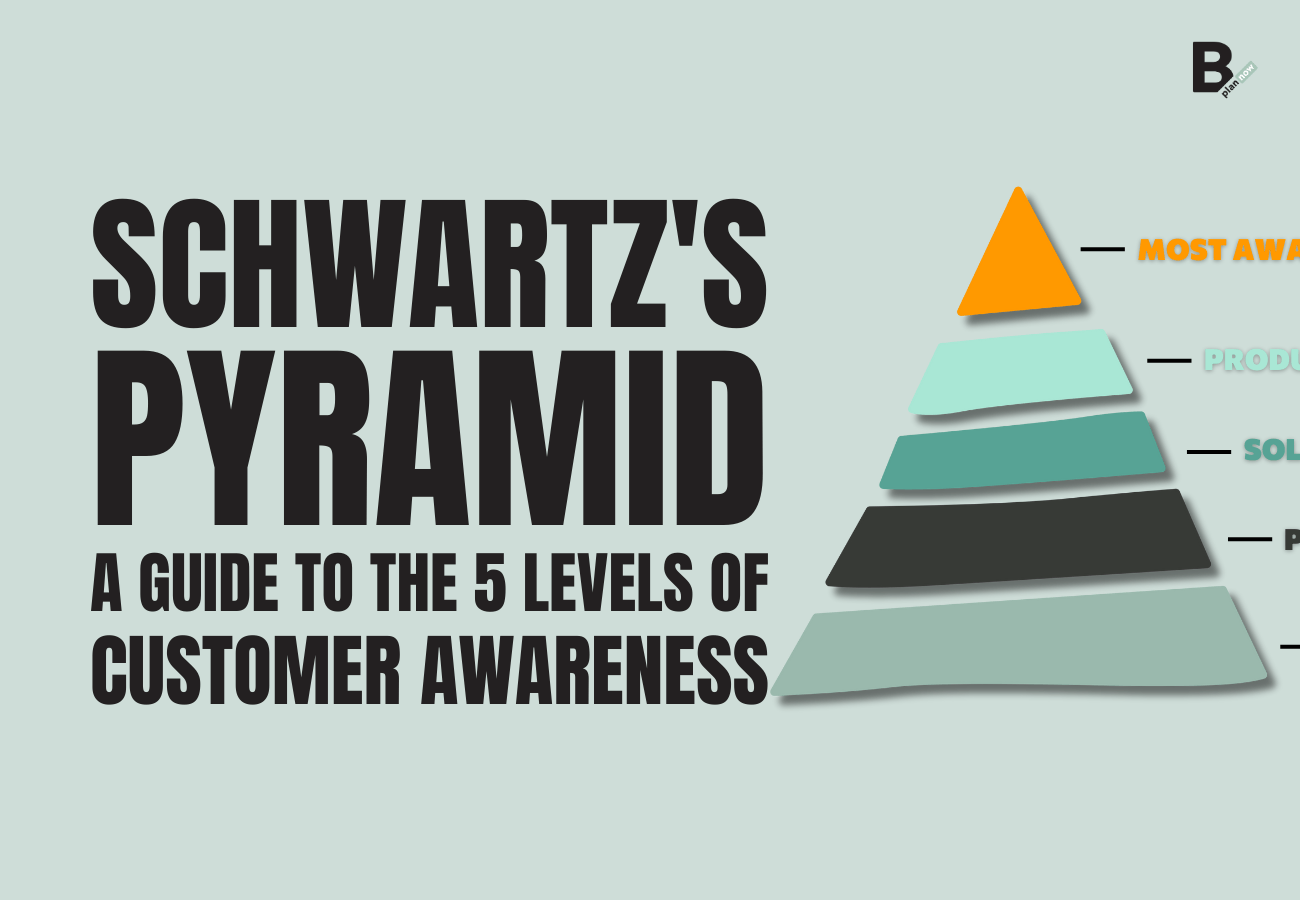
Messaging strategies
Before you start producing content, you need a structure.
Messaging is not just about writing punchier sentences: it's about understanding where each message lives, who it's for and what questions it answers. Two simple frameworks can help you think more strategically.
The hierarchical messaging framework
We can think of this strategy as a pyramid.
At the bottom, we place UI microcopy and micro-interactions across websites and apps: CTAs, error messages, empty states, forms, push notifications, confirmation messages, tooltips and alerts.
As you move up the pyramid, you'll find the product's core values and value propositions.
At the top there's the narrative story (the what, the why and the how), along with the brand voice.
At each level and touchpoint, we need to understand what users think when they interact with the product.
Through research and testing, you might uncover questions like:
- Discovery: What is this product? Do I need it?
- First use: Do I trust this product with my information? How do I get started?
- Guidance: How do I complete this action? Where can I find this information?
- Engagement: Where else can I use this product? How do I access this additional feature?
You'll notice these questions connect closely to the levels of customer awareness we saw earlier.
Once you gather feedback throughout the journey, you'll know which problems, frustrations, needs and goals to address. These are the questions your content needs to answer.
Read more in this case study by Bobbie Wood:
 Bobbie Wood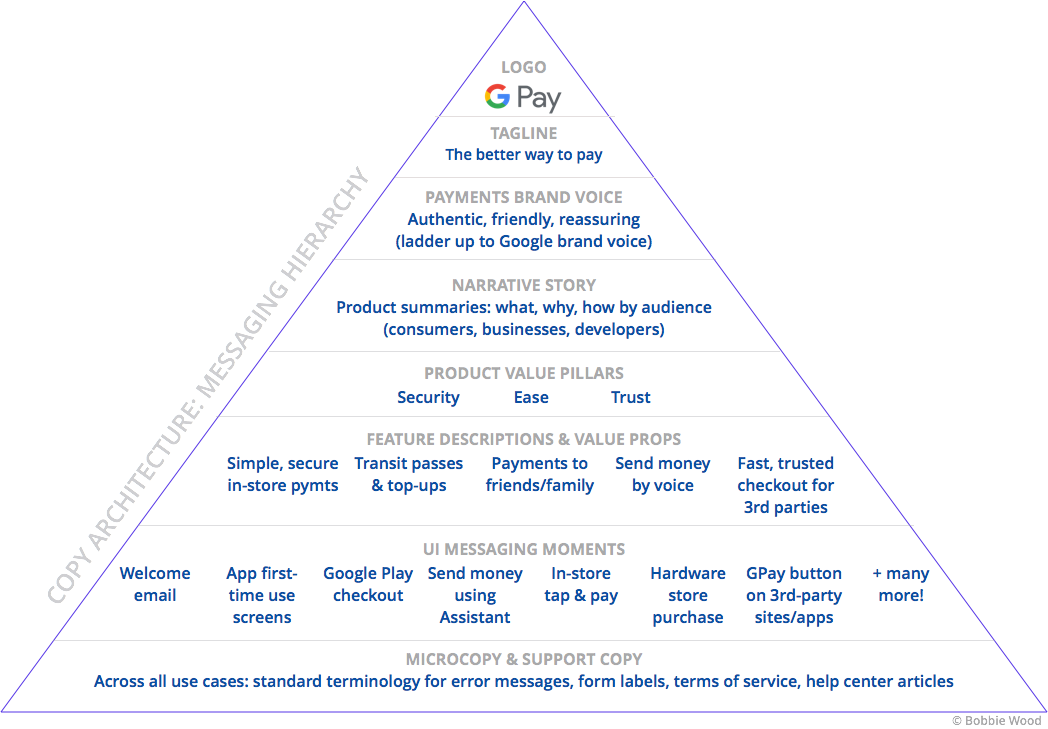
The audience-based messaging matrix
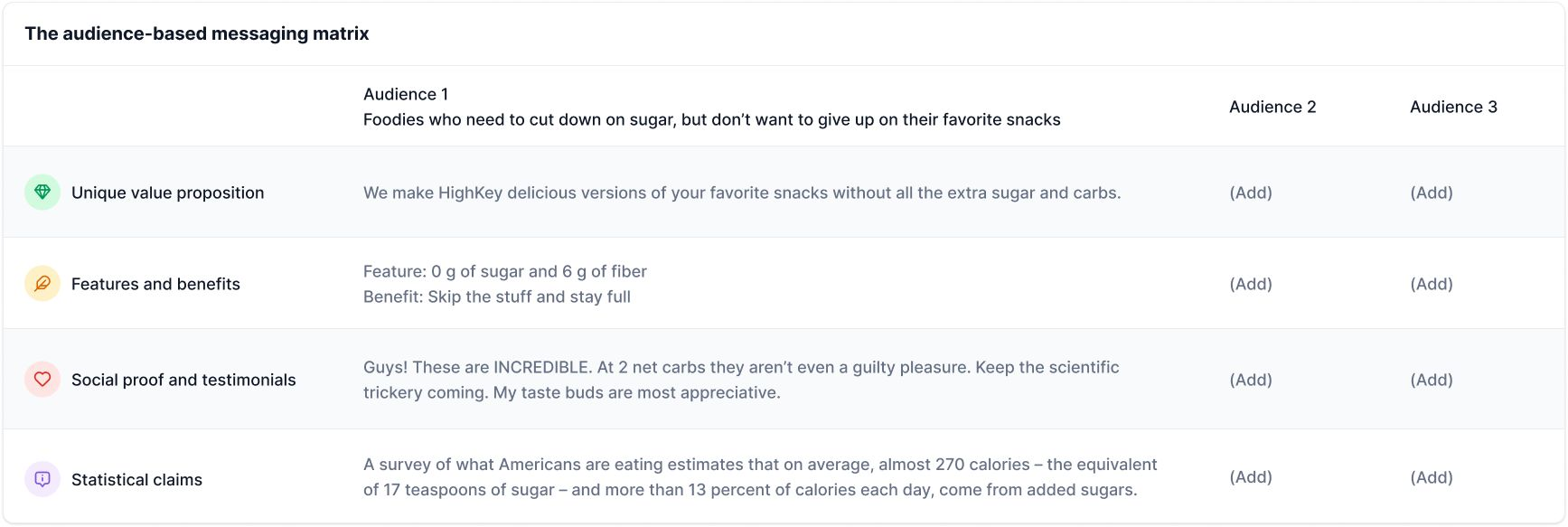
If the hierarchical framework is a pyramid, the audience-based messaging matrix is a spreadsheet.
Let’s use HighKey, the cookie and snack brand, as an example.
In your spreadsheet, list the key messages you want to communicate:
Unique value proposition
- Statement: "We make delicious versions of your favorite snacks without all the extra sugar and carbs."
Features and benefits
- Feature: "0 g of sugar and 6 g of fiber"
- Benefit: "Skip the stuff and stay full"
Social proof and testimonials
- Client review: "Guys! These are INCREDIBLE. At 2 net carbs they aren't even a guilty pleasure. Keep the scientific trickery coming. My taste buds are most appreciative."
Stats
- Claim: "A survey of what Americans are eating estimates that on average, almost 270 calories – the equivalent of 17 teaspoons of sugar – and more than 13 percent of calories each day, come from added sugars."
Repeat this process for each audience segment you want to address.
For example, the quotes above may appeal to foodies who need to cut down on sugar but don't want to give up their favorite snacks. Keep looking for other relevant segments you can build messages around.
Once you've populated your spreadsheet, you'll have the building blocks to create tailored content that resonates.
Examples:
- Blog posts on the dangers of eating too much sugar
- Social media carousels on how to identify added sugar in your diet
- Filtering e-commerce products by diet and lifestyle
- Easy-to-interpret breakdowns of key nutrition facts
- FAQs that address health-related questions
- Testimonials that highlight specific benefits
Learn more in this blog post on marketing writing by the UX Content Collective:
 Patrick Stafford
Content calendar ideas
Once you know your audience's needs, awareness level and messaging strategy, it's time to bring everything together. A content calendar can help you organize your ideas, plan ahead and ensure every piece of content is aligned with the brand's voice and values.
Research your audience
You don't need to be a seasoned UX researcher to understand what your audience is talking about online. You also don't need a large budget.
You can observe and listen to your audience using a variety of free tools.
Explore Facebook groups, subreddits, Quora Q&As and Amazon reviews to see what users are discussing.
You can also try Google Trends, AlsoAsked, AnswerThePublic, AllTop and SparkToro to uncover keywords and topics.
I tested all these tools and wrote about my findings in this post:
 Elisa Trippetti
Look for stories
To uncover interesting stories about your customer's brand, start by asking questions like:
- How did the company get started? How did you get started?
- How would you explain what you do to a child?
- What is your best success story?
- What is your most memorable challenge?
- What two sentences would you use to introduce yourself? And your company?
- What would your ideal media headline look like?
- If someone had only three minutes on your website, what takeaways would you want them to leave with?
Again, use what you've learned about customer needs, frustrations and pain points.
Craft headlines
I know: a lot of marketers say the title is the last thing you should write. Instead, I suggest jotting down a working headline first for each idea.
It doesn't have to be final, but it still helps you stress-test the idea and narrow the topic. Each headline becomes a core unit you can refine based on your experience and perspective.
This is also a great place to apply what you've learned about customer awareness.
To explore different angles, try tools like Sharethrough, CoSchedule Headline Analyzer or HubSpot Blog Ideas Generator.
Copywriting Tips For The 5 Levels of Customer Awareness. Source: Alex Cattoni
Wrapping up
When you feel stuck, go back to frameworks and structure.
Always keep your building blocks in mind:
- the most common human needs
- the needs, wants and fears at each level of customer awareness
- the audience segments you can address, from the top down to the bottom of the pyramid
- the brand's values, voice and narrative story
With all these inputs in place, it becomes much easier to come up with focused content ideas.

I'm Elisa, an Italian content designer and translator at heart who believes good design is service. This is where I document my life in UX and writing.
Let’s talk words
Get in touch on LinkedIn to talk about all things UX writing, content design and localization.
Contact me